Polar and Nonpolar Molecules
And other polar solvents but are soluble in nonpolar substances such as ether or chloroform. The energy between these molecules needs to overcome the barrier in the reaction.

Image Result For Polar Vs Nonpolar Molecules Covalent Bonding Chemical Bond Study Chemistry
Cells are composed of water inorganic ions and carbon-containing organic molecules.

. To visualize the amino acid groups picture a. Theres no element with more negative or positive charge than another side. Polar Molecule Definition.
Molecules such as Cl 2 H 2 and F 2 are the usual examples. The electronegativity difference between bonded atoms is less than 04. The most frequent active site amino acid residues out of the 20 amino acids forming the protein are polar amino acids aspartate.
If there is an unequal pull on the central atom because of unshared electrons then the molecule is polar. Phospholipids for example have non-polar fatty acid tails and polar phosphate heads Polarity is an important property of molecules that determines how they will interact with other molecules. If there is an equal pull on the central atom from all sides then the molecule is nonpolar.
Dipoles on one polar molecule can interact with other dipoles on other polar molecules in a process called dipole-dipole interaction. Inside our body we have both polar and nonpolar molecules which includes those 20 amino acids mentioned above. Although permeable to water a polar molecule the nonpolar lipid bilayer of cell membranes is impermeable to many other polar molecules such as charged ions or those that contain many polar.
Add 100 mL of a chosen nonpolar solvent to another beaker. Fat and oil molecules are nonpolar molecules so they cannot dissolve in water. Polar molecules occur when two atoms do not share electrons equally in a covalent bondA dipole forms with part of the molecule carrying a slight positive charge and the other part carrying a slight negative charge.
The electronegativity values are equal or nearly equal. Polar Molecules. The critical property of water in this respect is that it is a polar molecule.
The presence of nitrogen oxygen and other atoms adds variety to these carbon molecules. The key to the dancing colors in this experiment is soap. Soap molecules consist of a hydrophilic water-loving end and a hydrophobic water-fearing end.
Nonpolar and polar molecules exhibit some degree of electronegativity difference between bonded atoms1 Nonpolar bonds. This happens when there is a difference between the electronegativity values of each atom. Sharing between the two atoms of the electrons in the bond.
Polar molecules must contain one or more polar bonds due to a difference in electronegativity between the bonded atoms. Add a nonpolar solvent to a new beaker. Most carbon compounds are nonpolar.
As shown in the following diagram the polar head groups on the faces of the bilayer contact water and the hydrophobic alkyl chains form a nonpolar interior. Consequently the interactions between water and the other constituents of cells are of central importance in biological chemistry. Water molecules are polar molecules that can dissolve other polar molecules.
Likewise pentane C5H12 which has nonpolar molecules is miscible with hexane which also has nonpolar molecules. A side chain that differs on each amino acid. Polarity is a description of how different the electrical poles of a molecule are.
Lipid-soluble nonpolar molecules pass readily through a cell membrane because they dissolve in the hydrophobic nonpolar portion of the lipid bilayer. Complex molecules can be formed by stringing carbon atoms together in a straight line or by connecting carbons together to form rings. Nonpolar solvents include things like toluene gasoline and oils.
Molecules containing polar bonds have no. The phospholipid molecules can move about in their half the bilayer but there is a significant energy barrier preventing migration to the other side of the bilayer. As we have already understood above what are polar molecules now lets see some examples of polar molecules which are stated below.
What you should do is look only at the two atoms in a given bond. Let this beaker sit beside the water beaker. The bond present between oxygen and hydrogen is distributed such that the hydrogen atoms are on one the side of the oxygen atom.
A notable exception is carbon monoxide CO. Electronegativity values are useful in determining if a bond is to be classified as nonpolar covalent polar covalent or ionic. This means that polar molecules can more easily chemically bond with other polar molecules.
Water H 2 O is a good example of a polar molecule that can be seen in our daily surroundings. An extreme difference forms an. CH 3 Br or CH 3 F Concept introduction.
Other nonpolar molecules include carbon dioxide CO 2 and the organic molecules methane CH 4 toluene and gasoline. If they are highly different it can be said that the species is a highly polar molecule. The division of a sample of a substance into progressively smaller parts produces no change in either its composition or its chemical properties until parts.
We will use the Like Dissolve Like guideline to predict whether a substance is likely to be more soluble in water or in hexane. Substances composed of small polar molecules such as acetone and ethanol are usually soluble in. Textbooks typically use a.
A non-polar molecule has a structure of its atoms lined up in a way that the orbital electrons in the outer region cancel out the electronegativity. Nonpolar molecules can bond with nonpolar molecules but it is not quite as easy for them. Whereas the Linear molecules are said to be non-polar in nature.
In general pyramid-shaped and V-shaped molecules are said to be polar. Intermolecular forces operate between the molecules so changes with change in the phase. Weve created many models that dynamically illustrate scientific concepts and allow you to interact with molecules or macroscopic phenomena like pendulums at right and their environment in various ways.
An amphipathic molecule is a molecule that has both polar and non-polar parts. Water is said to be a polar molecule due to the difference. A covalent bond is a chemical bond that involves the sharing of electrons to form electron pairs between atomsThese electron pairs are known as shared pairs or bonding pairs and the stable balance of attractive and repulsive forces between atoms when they share electrons is known as covalent bonding.
A polar molecule is a chemical species in which the distribution of electrons between the covalently bonded atoms is not even. Polarity is like a game of tug-o-war. Water is the most abundant molecule in cells accounting for 70 or more of total cell mass.
Many nonpolar solvents fall into the category of volatile organic compounds VOCs and are quite dangerous. The Molecular Nature of Matter and Change The intermolecular forces present for each substance in the following pair are to be identified. In chemistry polarity is a separation of electric charge leading to a molecule or its chemical groups having an electric dipole moment with a negatively charged end and a positively charged end.
Molecule a group of two or more atoms that form the smallest identifiable unit into which a pure substance can be divided and still retain the composition and chemical properties of that substance. Some chemical species such as chains. The chemical properties of amino acids are largely determined by one group of molecules whats known as the R group.
This happens because the. Water is a polar molecule. Molecular models are the heart of Next-Generation Molecular Workbench.
There are three. Examples of homonuclear nonpolar molecules are oxygen O 2 nitrogen N 2 and ozone O 3. Also the substance that has a higher boiling point is to be identified.
For many molecules the sharing of electrons allows each atom to attain the. Any two molecules have to collide for the reaction to occur along with the right orientation and a sufficient amount of energy. Molecules that are asymmetrical tend to be polar.

Polar Nonpolar Covalent Bonds Ch 6 Youtubea Little Too Detailed Though Covalent Bonding Chemistry Classroom Chemistry Lessons

Hf Is Polar Or Nonpolar Covalent Bond Covalent Bonding Polar Molecules
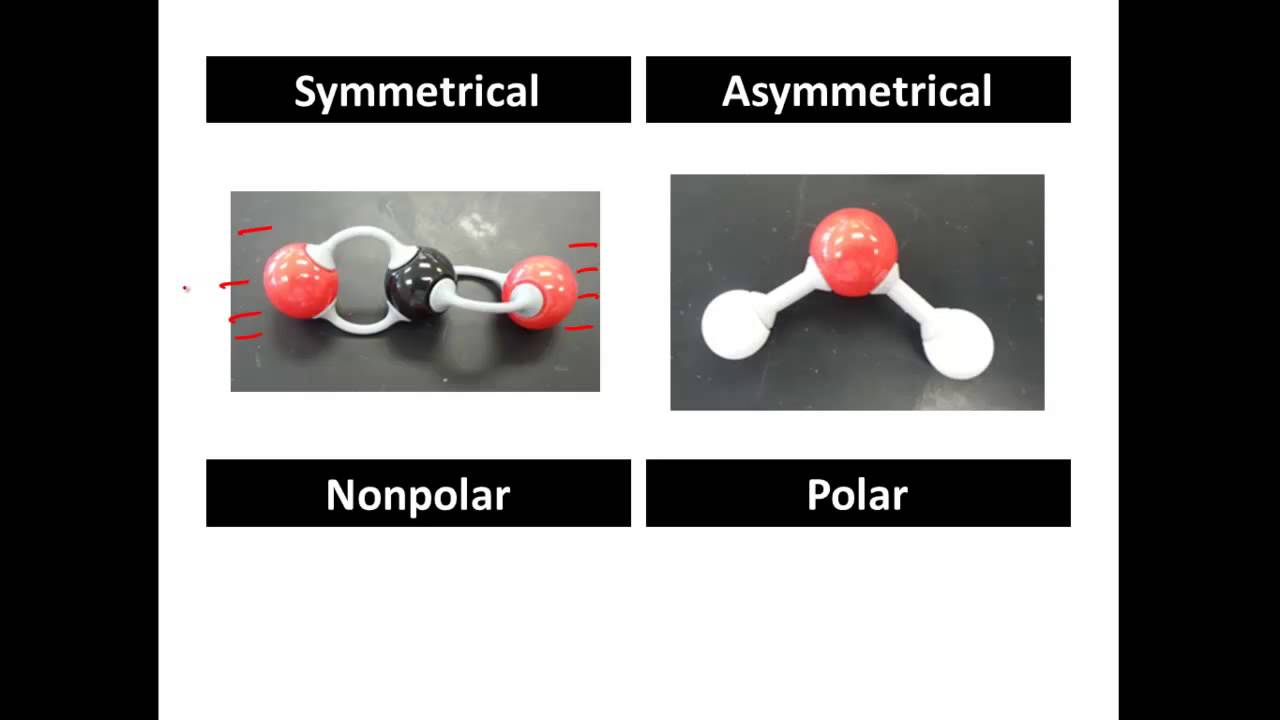
Polar And Non Polar Covalent Molecules Polar Vs Nonpolar Youtube Playlist Science Chemistry Science Activities Chemistry
Polar And Nonpolar Molecules Covalent Bonding Chemistry Classroom Chemistry Lessons
No comments for "Polar and Nonpolar Molecules"
Post a Comment